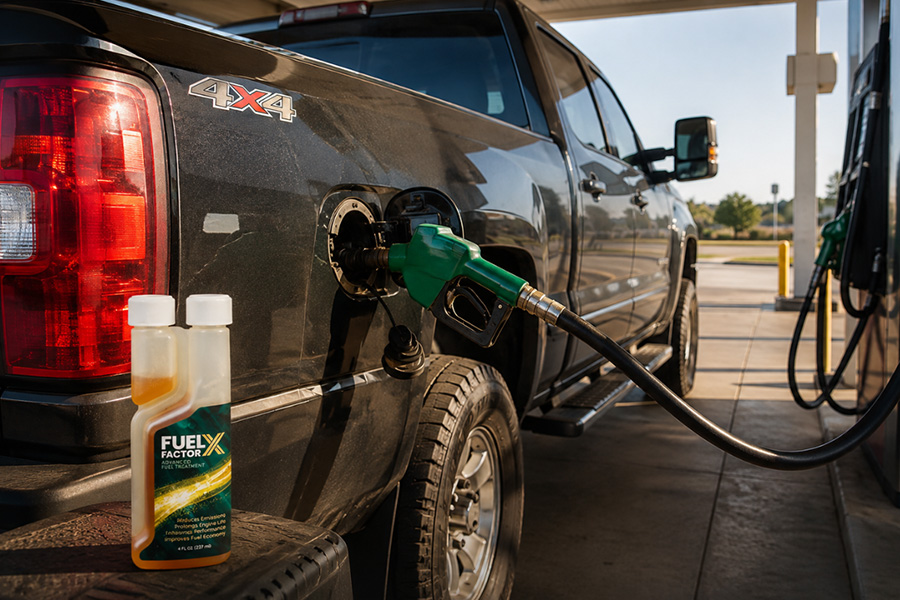
Diesel trucks are built to handle heavy work, long trips, and high mileage. Many owners depend on their trucks for towing, hauling, farming, construction, or daily transportation. When the truck is not running well, the extra fuel cost and lost time can add up quickly.
A diesel engine needs a steady supply of clean fuel delivered at very high pressure. Fuel injectors must spray the right amount of diesel into each cylinder at exactly the right time. When deposits affect that spray, combustion may become less even.
A quality diesel fuel treatment can help support cleaner injectors and smoother combustion. Fuel Factor X is a concentrated fuel treatment designed for gas and diesel engines. For diesel truck owners, it can become one part of a regular maintenance routine.
Why Diesel Injectors Matter
Diesel injectors work under extreme pressure. Their job is to break the fuel into tiny droplets so it can mix with air and burn inside the engine.
A clean injector creates a controlled spray pattern. This helps the engine produce steady power from the fuel being used. If deposits begin to form around the injector tip or inside the injector, the spray pattern may change.
Instead of a fine and even mist, the injector may deliver an uneven stream. Some areas of the cylinder can receive too much fuel while others receive too little. This can lead to rough operation, slower throttle response, added smoke, or a drop in performance.
Dirty injectors are not the cause of every diesel problem. A clogged fuel filter, weak pump, faulty sensor, turbocharger problem, or worn engine part can produce similar symptoms. Ongoing problems should always be checked by a qualified diesel technician.
Carbon Buildup and Diesel Engines
Carbon is created as part of the combustion process. Modern diesel engines also use systems such as exhaust gas recirculation and diesel particulate filters to control emissions. These systems do important work, but soot and carbon can still collect in different parts of the engine.
A fuel treatment does not directly clean every carbon-covered part of a diesel engine. For example, an additive placed in the fuel tank may not clean heavy buildup inside an intake manifold or repair a blocked diesel particulate filter.
However, keeping the fuel injectors cleaner can support a better spray pattern and more even combustion. When fuel is delivered properly, the engine has a better chance of using it efficiently.
Fuel treatment should support regular maintenance, not replace it. Oil changes, fuel-filter replacement, air-filter checks, and manufacturer-recommended service are still important.
What Does Reduced Lubricity Mean?
Diesel fuel does more than provide energy. It also helps lubricate moving parts inside certain fuel pumps and injector systems.
Ultra-low-sulfur diesel, often called ULSD, has been the standard for highway diesel fuel in the United States for years. Removing sulfur helped reduce harmful emissions, but the refining process can also remove some of the fuel’s natural lubricating compounds.
Fuel standards now include lubricity requirements, and fuel suppliers often use additives to meet those requirements. According to the U.S. Department of Energy’s Alternative Fuels Data Center, lubricity standards and additives were put in place to help address fuel-pump concerns connected with ULSD.
This does not mean every gallon of diesel has poor lubricity. It means lubricity is an important part of fuel quality, especially in modern high-pressure systems.
Truck owners should avoid assuming that every additive improves lubricity. Products have different formulas and purposes. The label should clearly state what the product is designed to do.
High Fuel Costs Make Efficiency Important
Diesel trucks often have large fuel tanks and travel many miles. Even a small loss of fuel economy can become expensive over time.
Injector deposits may interfere with fuel delivery and contribute to a loss of efficiency. Cleaning those deposits may help restore some lost performance when deposits are the cause. It will not create fuel savings beyond what the truck and its operating conditions allow.
Truck fuel economy is affected by many factors. Heavy loads, towing, tire pressure, idling, speed, weather, terrain, and driving habits all make a difference. A fuel treatment cannot overcome these conditions.
The realistic goal is to help a properly maintained engine make better use of the fuel it already has.
Do Diesel Injector Cleaner Additives Actually Work?
A diesel injector cleaner can work when it contains effective cleaning ingredients and injector deposits are part of the problem.
Some engine manufacturers have tested and approved certain additives for specific uses. For example, Cummins has recommended tested diesel additives to address concerns such as injector deposits, poor lubricity, low cetane levels, and cold-weather operation. This does not mean every additive works the same way or is approved for every diesel engine.
A cleaner may help remove or control deposits as treated fuel passes through the fuel system. Drivers may notice smoother idling, easier starts, better response, or more consistent performance if deposits were affecting the injectors.
An additive cannot repair a failed injector, damaged pump, blocked filter, or worn engine. If a truck has serious power loss, heavy smoke, warning lights, or hard starting, it may need professional service.
What Happens if You Use Too Much Diesel Injector Cleaner?
More is not always better. Fuel treatments are made to work at a certain concentration. Adding far more than the recommended amount changes the balance between the treatment and the fuel.
Depending on the product, overuse could affect how the fuel burns, reduce fuel quality, or place unnecessary stress on fuel-system parts. It may also waste money without providing any added benefit.
If too much treatment is added by mistake, do not guess about the solution. Check the product directions and contact the product manufacturer. For a large overdose, contact a qualified mechanic or the vehicle manufacturer before operating the truck.
Always measure a concentrated product carefully. The correct amount should be based on the number of gallons being treated, not simply the size of the truck’s fuel tank.
Vehicle manufacturers may also have their own rules. Ford advises owners not to use aftermarket additives unless they meet Ford’s stated specifications and address a specific concern. Check your owner’s manual before adding any product to the fuel.
Is Diesel Treatment Really Necessary?
Diesel treatment is not required for every truck at every fill-up. Fuel sold at the pump must meet basic standards, and a well-maintained truck using good-quality fuel may operate normally without an extra treatment.
Still, some owners choose treatment for added support. It may make sense for trucks that work under heavy loads, travel long distances, sit unused for extended periods, or operate in changing weather. It may also be useful when fuel quality is uncertain or deposits are a concern.
The correct answer depends on the truck, the fuel, the conditions, and the product being considered.
Adding Fuel Factor X to a Diesel Maintenance Routine
Fuel Factor X is a concentrated diesel fuel treatment that can be added during a fill-up. It is designed to support fuel-system cleanliness, smoother engine operation, and cleaner combustion in gas and diesel engines.
Because Fuel Factor X is concentrated, it is important to follow the dosage instructions on the package. Using the correct amount makes it easier to include the treatment in a regular routine without over-treating the fuel.
Fuel Factor X is not a replacement for good diesel fuel, scheduled maintenance, or needed repairs. It is an added step for truck owners who want to support the fuel system between normal service visits.
For diesel owners facing high fuel costs and demanding driving conditions, taking care of the fuel system can be a smart part of taking care of the entire truck.
Results vary based on engine condition, maintenance history, fuel quality, driving habits, vehicle type, load, and product use.